If the first step is having an idea, then the second step is developing a research plan based around that idea. What is this about? What does it need then for it to be about that? The idea itself may not be set in stone. That will mature over time, mutate, change and grow along with you as you engage with the creative process. Engagement with the task of idea generation, however, is the most exciting phase of the whole process. When you are not sure exactly where it is going, but you know it’s heading in the right direction, at least much better than if you did nothing at all. Don’t worry too much about the right name of the project. At least not yet anyway. That will follow and may iterate, even after its release, as many times things do better the second time round after its initial name and art is changed.
SO THEN, WHAT IS THIS ABOUT?
Well, a couple of things. This is about philosophy, psychology and psychiatry, particularly neuroscience, and how these three disciplines can elevate and evolve our mental state in consciousness, increase our physical potentiality and achieve an extraordinary sense of wellbeing, contentment and fulfilment, through experiencing flow, which involves creativity leading to happiness daily through the psychological way we engage with our everyday life.
We are now living in the age of technological abundance, technology addiction and artificial distractions. Trends of rising depression and suicide among young people is steadily increasing and higher than ever with kids now needing counselling far younger than any other generation in human history. And this rising trend runs parallel to the exponential rise of technology. While this is the golden age of information, which is incredible for anyone now being able to access any form of education and learn anything whatsoever from inside their pocket, not everyone is actually using it that way and rather than increasing our mental faculties through the deliberate use of the technology, information overwhelm has led to far too many people losing their grip on reality, and even losing their own lives.
Finding the meaning to life therefore is perhaps more important now than it’s ever been. And we may even need far more resources like this to help us navigate the disruption digital tools have had (and are still having) in our lives with constant communication distractions.
In the next 5-years (2031) it is predicted at least 25% of people’s jobs will no longer be needed due to artificial intelligence. There has even been talks that a universal income may be necessary in order to support people struggling to find meaning in a society that no longer requires them. It’s a scary time for anyone who works with computers, as many will be replaced by automation. There has never been a better time in history, to be a plumber.
The ideas and strategies presented here then are to teach you how to alter your existing brain’s neurochemistry, cultivating a path not merely to survive but so you may thrive in the next century. Through developing extreme discipline, dedication and an unusual amount of intense focus into a daily practice that you can use and rely on during difficult times in order to bounce back time and again to eliminate any chaos that may precede in life.
You will be able to adapt yourself into the circumstances of any moment. These lessons are timeless and will show you the way to remain calm and steady inside a turbulent world.
Right now we have access to more information than we ever have in history, and yet people only feel more overwhelmed than successful. We possess the ability to learn anything we desire. So technology has significantly improved our lives in these ways. However. for many it is leading them astray, warping and even distorting their minds, and actually decreasing and depressing them in the process. Technology has the ability to improve our potential, increase our intelligence, enrich our lives and enhance our cognitive complexity, but only when we use it as the master, not as the slave being directed to where it wants to take us.
This is therefore also about how to live successfully in the digital age of information overload.
This will teach you:
– Better ways for leading a far richer, more fulfilling creative, productive and enjoyable life.
– How to feel calmer and less anxious during turbulant times.
– Why being deliberately slower is a much better strategy to being far more productive.
– How to become and remain focused, present and actively engaged with your life.
– Identifying and eliminating the toxic types in your life who try to hold you back.
– Why it’s a terrible idea to ever concern yourself with other people.
– How to connect with your physical and mental self from a much higher level.
– How to live each day, fully concentrated, unshakable and undistractable.
– Why digitally decluttering your life is extremely important for your mental health.
– Allowing room in your attention for only what matters most: your mind and life.
– Finding your calling to discover a higher quality experience to your existence that you never even knew was possible.
From a philosophical perspective, this part comprises three themes that relate to everything each of us will experience in our lifetime no matter what: the everyday engagement of our life and with other people, happiness and the hope to achieve it, death and the hope to avoid it. How do I live good? Can I find happiness? I have to die one day. Should this ever bother me?
We will do our best to discover and unlock the mystery behind why some people can find happiness, while many others fail to achieve it. What makes for a happy life and can we achieve it?
Based on ancient wisdom integrating timeless principles on the art of living, and dying, well, we will also be examining the lives of those we assume are much better or happier than our own to also learn why riches, fame and extraordinary success don’t always ensure a happier life, along with the pitfalls and dangers in aspiring towards the wrong things, before it’s too late, or we miss the point, to live without any regrets. We will also see how having little and living hidden can even lead to living more happily.
From a psychological perspective, each of us has been created with our own exact genetic makeup and psychological structure that is totally unique to who you are. There is no getting around this fact: who you are is very much a result of where you have come from, where you have been and all of the choices you have ever made. Living in a world surrounded by other people, each of whom are all made of their own ‘stuff’ too. And although we look alike, the human kingdom is similar to the animal kingdom.
Each of us has living inside of us our very own animal, whether we are aware of this or not, or deny this fact being true about us. There is an animal inside of you that makes you, you. We therefore live in a world surrounded by good and bad animals, disguised as people, and we can’t always tell who is who. Even though we seem stuck with ourselves, however many of us are strangers to ourselves. Yet you would be surprised to know that it is quite possible to change who we are. This power to change yourself lies completely within your reach. We cannot change others, as many animal types never feel the need to reform, as they see themselves as already perfect. So when it comes to dealing with and handling dangerous animals on Earth, knowing how to change our psychology is a matter of life and death.
From a psychiatric perspective, how and why any of this takes place or is even possible all starts from the perceptual contents of your consciousness. From inside your brain, the conscious and unconscious mind whose eyes observe everything in the physical environment. The neurological processes that take place inside the eye of your mind form your identity and ego, which therefore dictates how you behave and act in the world. Everything that you do from the way you think, act, behave, walk and talk is all neurological in order to create a persona from your perspective, which can never be experienced by anyone else but you, to form a mental representation in the eyes of another to influence their perception of who they think you are, the character you believe and suspect you are to other people in the outside world.
This psychiatric conditioning of your mind therefore seems to inform everything you ever do. Should particular network regions of your brain become damaged then the structure that makes you, you, can be lost, losing your identity. Are we actually who we think we are then? Or, are we just a complex bunch of complex neurons firing in a particular way to trick us into thinking we are who we are? The fabric of your personality is predetermined by what takes place inside your mind. But who you are today is not exactly who you were as a child, even though you are the same person. This same principle can be applied to the types of activities you engage with which will also influence and dictate what happens in and to your mind, who you become in the future.
While we do see many people who seem to remain the same as they always were, unchanged from a decade before, we can radically alter the state of our brain conditioning through particularly chosen physical and mental activities to change, or even reverse, the chemical structure of our brain to give rise to all kinds of qualitatively positive changes of experiencing our everyday life. All of the things we either do and through all of the people and places we come into contact with play a huge role in determining who we are and who we end up being or becoming. Therefore we can influence positive changes in who we are.
We might not always get to choose what we want in life, but we can always choose how we respond to the events in our life. What to do about it, how to think, act and take ownership over the resources available to us. We can do our best to make each moment matter, making the most of every experience, good and bad. Things that come easy teach us nothing, and when things are too easy for too long, any inevitable hardship is only going to be much harder to endure, or even survive. The brain, however, can become hardwired to not merely endure difficulty but also learn to manage and enjoy struggle. We have to be willing to deliberately seek far harder experiences, on purpose, turning the adversity of hard times into skilful practical advantages.
How we leverage each of these disciplines is the key: philosophy gives us a better way of seeing the world around us, situations and people, how to deal with them, manage it, and navigate our way successfully around each obstacle that comes our way. And not only how to manage it, but make ourselves even better because of it, cultivating a mind of psychological robustness in a world where many people’s minds are now shrinking both in complexity and into anxiety. This will reverse that process of overwhelm and how to restore that calm. Hard times are never easy. But, that doesn’t mean they still can’t be fun.
Finally, why you should perceive that everything in life happens for a reason and how we can take all of our experiences, negative and positive, to transform our mind and life, influencing who we ultimately become. We can either rise to this occasion, or collapse under the weight and stress of difficulty. We can give up, or go beyond our present level ability. And in that process we have the potential to rewire the structure of our brain and push our evolution further along to support the next generation.
Philosophy is all about our perception, how we see things. Psychology is about our inner and outer experiences, how we feel likes. Or don’t feel anything at all. Psychiatry is about neuroscience, how our brains and minds function. When we master all three we become masters of our reality, transcending the limits of our physical and mental self. We can’t do much about external circumstances. However we can always decide how we respond to what happens to us, is the lessons the stoics teach us. No one has the one and only answer. However, I’ve found some of these lessons to be a great way to live your life by.
I’ve listened to people who are millionaires struggle to answer the question: are you happy? I’m on the bottom rung of the financial ladder. I’ve been working minimum wage since I left school. I struggle every month just to keep my head above the water. And it’s been like that for over a decade now. But I never fall off the track. In fact, I turned down job opportunities that offered me more money. Why? Because I value learning more over money. I never lose sight of my task. I keep my head down and struggle onwards and upwards and continue to do whatever is necessary. That’s what everyone else is doing. I may be broke after paying all of my bills at the of each month. But I have a lot to show for it and therefore I’m always happy with everything I must pay for.
My golden rule each month is: buy books, pay your bills, then with whatever is left, feed yourself. But books must always come before food. I don’t stop to eat lunch on any day. I only stop at lunch to read and write. Books are food for the mind. And when at the desk reading and writing, I forget I’m even hungry.
So you may encounter countless hardships, yet you can still somehow feel happy at the end of almost every day even when bad or hard times are happening. We may need to come back and clarify this idea in more detail later though, as happiness can mean different things to different people and I’m aware that my definition of the term may be misunderstood here in terms of what it means to others. And I may be wrong in my assumption and therefore need to investigate the matter further to understand the concept better. And not to mention the matter of personality will probably also make a difference too. For instance, why does somebody see the glass half empty when it is half full?
Nonetheless, we will all experience good times with the bad. So what matters during difficult times is knowing how best to direct our aim towards a practical purpose, so that one shall not fail at finding the way back to achieving happiness. Fame or riches not only don’t always ensure happiness, but as we shall see, too much success can be a tragedy and destroy people’s lives. However, enough income is essential as being homeless would make it far harder, I would imagine, to be happy each day. Therefore it is a blessing to have enough and knowing how to be happy with that enough, knowing when the enough you have is already too much is an incredibly useful tool for being grateful with everything you have. So even after you have paid all of your bills at the end of each month, it feels amazing to be skint. Because I can still pick up a book, go to the library, play with the kids, walk the dog, enjoy the gym, have a roof over my head, and a phone in my pocket that enables me to be able to do this.
The point: you don’t need to have more money than necessary in the bank to achieve happiness. You just need to know how to live.
BE PREPARED FOR THE WEATHER NOT MOVING IN THE DIRECTION YOU WANT IT TO GO IN: INSTEAD, MOVE WITH THE WEATHER IS ALWAYS FAR BETTER IDEA
Prepare yourself for the weather not moving in your favour and adjust yourself accordingly into whatever present landscape you find yourself in and adapt yourself into the conditions of the current climate. Doing what is difficult is never easy, obviously. However, if necessity calls for it then it is essential to do whatever is necessary. The landscape is forever changing. You must therefore shift in order to move with the times and never play it safe in order to survive. You’re going to have to be willing to struggle and remain focused on the long-term goal.
This is perhaps one of the most common infuriating, although somehow paradoxically exhilarating things about the creative process: every time you think you are finally ready and done, you realise you are still not even close to beginning. And this is merely the beginning of yet another start point discovering that not only have you not yet begun, but everything you’ve been doing up until now has all been for the purpose of being able to start. Only this time you’ll have quadruple your efforts.
Never delude yourself with the idea that it’s nearly time to relax. A mind that is made to slow down from functioning optimally will shut down and die earlier in life than it should. You want to always practice striving to be at your best, optimally. For every time you do so, you’re one step closer to more of your hidden potential.
If the goal is to do it not for the money or the fame then the big question for many who would only attempt to do such things if on the other side there is some monetary reward for it all, why bother to create in the first place? Why put yourself through all that effort? Why care?
And the answer to that question is very simple:
The reason why you should create is to discover how much of your potential you can actually achieve when you apply yourself and care enough to try. Because learning is a pleasure. Studying is a pleasure. Using your body and mind is a pleasure. Because you want to do something deep and meaningful. You want to continue achieving optimal experiences And if someone’s not going to reward you, financially, for deliberately engaging in the endurance of your own mind and body activities, what exactly are we saying? That it is much better to become fat, lazy and stupid?
When was the last time we asked the question whenever someone announced they are running in a marathon, how much are you doing that for? Almost every person who runs a marathon does so in order to give money to others. They put themselves through all of the difficult training and pain all in the hope they may receive money to give away to others, to a better cause.
You can see why now people who enjoy mental marathons love to run real marathons too. There is a causal link and relationship between the two. The guy who runs marathons and creates is going to create from a different level than the guy who doesn’t want to get off the sofa. Many people also only run marathons, so they can be better at their work. So if you wish to enhance creativity, a great begin would be to run a few marathons to unlock some of that what we are talking about.
Also, it’s much better to wake up each day with a great sense of meaning, mission and purpose to your life, having a fulfilling task that continuously drives you and improves the self, physically and mentally challenged, deliberately, all in order to achieve this attainment of a sounder mind and body. Not living distracted or letting ourselves be distracted by sex, drugs, food, alcohol, gambling, scrolling, passive living, all forms of hedonistic pleasure and from my observations, studying these habits, rarely leads to lasting fulfilment or peak state sustained happiness.
Never waking up hungover or ever suffering with indigestion from the night before, excited and motivated about each day ahead, including every Sunday, and Monday. Waking up instead everyday with a new goal to focus on achieving for that day. And it only needs to be one small thing each day. But enough of a small thing each day to be excited and know what the goal is.
Without these things, the meaning of life may either be diminished or lost entirely. Therefore:
1: Know what you want to do.
2: Want to get up and get at it.
3: Never care about externals that are out of your control.
FOCUS ONLY ON WHAT IS IN YOUR CONTROL
You must ensure that what you choose to do ultimately fulfils and satisfies you, letting you derive pleasure inside each day through the psychological engagement of your own life, demanding more from yourself, pushing yourself into achieving this active state, living a far greater, much more rewarding, balanced and happier existence. You need not have lots of material things to experience this sensation in your life. I would say however that certain resources are essential in order to apply this to happen in your life, which is why it’s important you also choose carefully everything you decide to do, and ensure that every decision revolves around this active engagement towards achieving the purpose that you feel compelled to do, the reason why you feel like you’ve been put on Earth. And once you have established what that is and you know that it is going to occupy and fill a very large portion of your one and only finite lifetime, you have arrived at the point. And it will be very hard to wake up each day not feeling excited and happy about the task for the day ahead.
It’s up to you to find this task and it’s perhaps more important now than ever that you do. Understand: no one cares about this or is more excited about it than you are. Make sure then it is something that will always remain to excite you, regardless of external outcomes. Above all else, do it to please yourself. People are already getting far too much and much more than anyone will ever be able to consume. So make sure that it makes you happy, first and foremost. It’s actually my biggest regret in life now. Not having been able to perform academically sooner. I wish I had this ability to love learning the way I do today, the way I couldn’t back then. There is nothing more stimulating than being intellectually curious, always wanting to learn and know more.
This then, I hope, inspires you to take that same path too into avoiding distractions, and hopefully much sooner than many others, and run with this program now for the rest of your life.
You have far more hidden potential than you are even aware.
You have an opportunity. And the opportunity is the chance. The chance of what? Having interests that you can pursue with the free time of your life. Your time is limited. So use your mind wisely, and with whatever time you have left, use it well. Go now and become all that you can possibly become.
Remember: everything is draft. I may try several more attempts at this before finding a better way to express it. Then I might throw most of away and pluck anything good from the rough. If there is even any there. It’s just an idea. That’s how it works. You show up. Work. Go to bed. Wake up. Go to work again. That’s it.
Your reality is a reflection of the choices and actions you have either made or make. So be sure to always make the right choices and right actions. That way, your reality will always be well, regardless of whatever happens. Carry out the wrong actions for too long, that’s when bad things start to happen. However, if it is not good we must give serious thought to the idea of where we have gone wrong and strongly reconsider if our choices may have been inappropriate. Then do the hard part. Which is, the work. On ourselves. Accept our flaws. Accept our mistakes. Accept our weaknesses. Accept our wrongdoing. Then desire and seek the way to change. Want to do better. Want to be better. Want to make it better. Want to never let that happen ever again. Be then who we are capable of being, right now. Not who we pretend we are. Seek the way to improvement thus increasing our ability to not only understand ourselves better from another person’s perspective, but to also increase our empathy towards other people, so we can also be better to them, for them. To be the best for those who rely on us and need us the most.
THE PHILOSOPHY OF PSYCHOLOGY AND PSYCHIATRY
How to Rewire Your Brain, Reprogram Your Life and Turn Chaos into Happiness
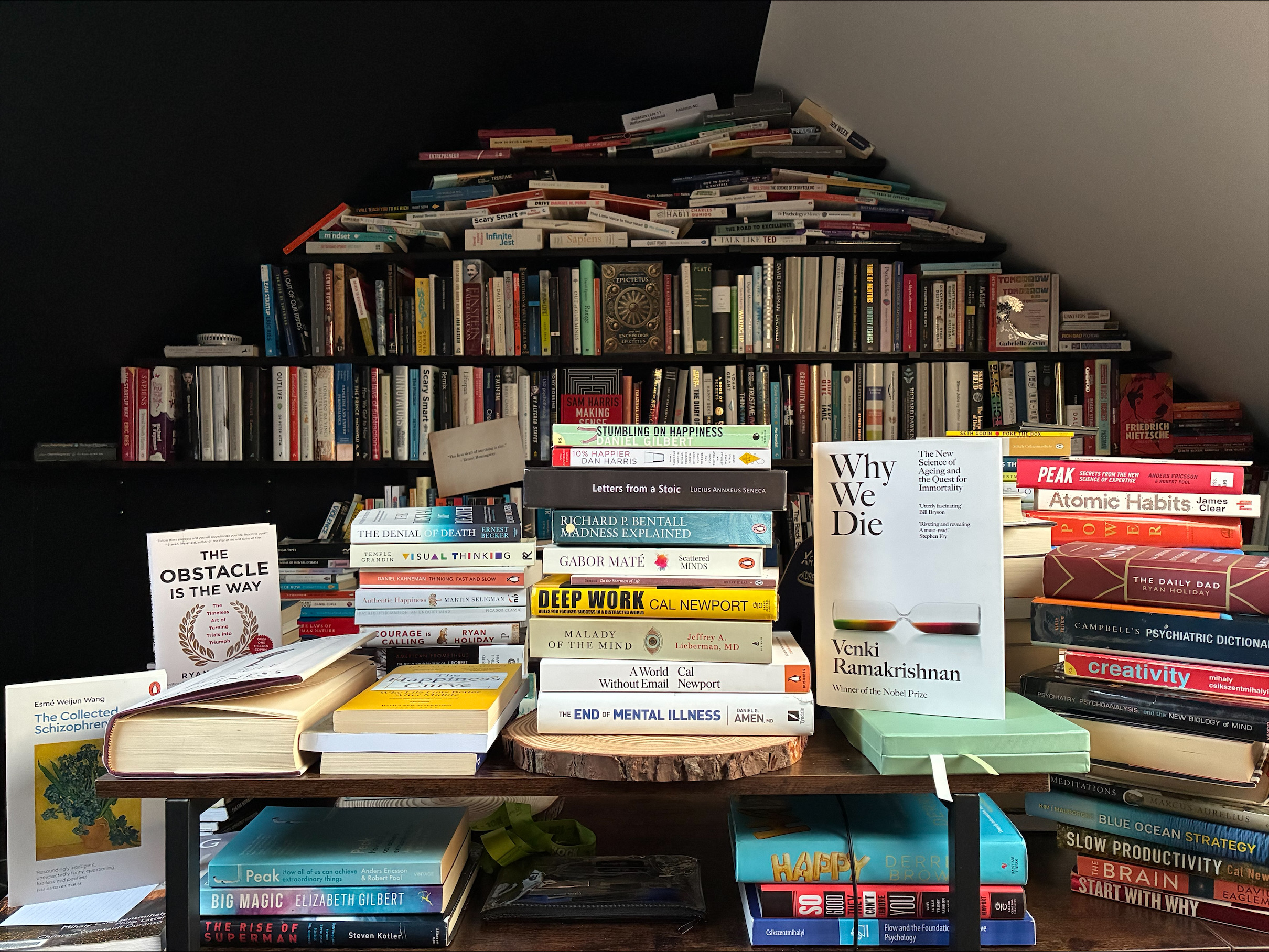
In order to experience deeper levels of monotropism, what are we going to need? Take the view from above. Branching out from these three disciplines: philosophy, psychology and psychiatry.
What is necessary to further the branches of that tree?
Classic books on life
Classic books on happiness
Classic books on death
Classic books on philosophy
Classic books on psychology
Classic books on creativity
Classic books on flow
Classic books on mental health
Classic books on psychiatry
Classic books on neuroscience
Classic books on mental disorders
Classic books on the mind
Classic books on mental illness
Classic books on medicine (this includes music)
Classic books on medical
Classic books on drugs
Classic books on the meaning to life
That exercise alone should take you a month now developing the research before you are even ready to begin starting reading the research, which will take around 5-years at least to read it all.
The thing that you are trying to do must always be far smarter than you. Don’t be afraid of being wrong. And never be afraid of trying. Be afraid of never trying. Be afraid of never starting. Be afraid of never finding out how much you can actually become. But never be afraid of being wrong. The whole point in publishing your thoughts and ideas is to then go to work on them and investigate further and refine over time, cross-examining yourself in the hope that you will in fact prove yourself wrong along the way. That’s the scientific method. And if you do that, that’s great. That’s called a discovery. But don’t be afraid of becoming a researcher and investigator of your own mind. That’s allowed.
Being a researcher may lead to failure. But that’s exactly why you should do it. The way to succeed at anything, is to first fail at it.
They say you become what you read. So, read what you want to become. And if people say why bother with all this? The answer is: the same reason why you do what you enjoy. Some people enjoy food, sex, drugs, alcohol, even crossword puzzles, play and/or watch football, paint, draw, and as cringey as one this sounds someone suggested to me one day while I was very busy listening to a book wearing my headphones, that I should take them out, and instead, ‘socialise’. Something which I am not great it, never have any interest in, nor time for. It’s also a great way to waste time when you are supposed to be working.
I just love to read and write all the time. And I can’t stop. It’s Friday night. And while many are out now getting pissed, I just wanna draw research plans and set about to finding 500 books to add to my Amazon basket, then spend the next decade learning as much as possible. Going for a pint on Friday now is going to a barista bar for a lux cappuccino, then getting down to some real, serious work.
IF YOU WANT TO HAVE AN INTERESTING LIFE: GO AND DO INTERESTING THINGS
Either use your brain, or lose it.
It’s that simple.