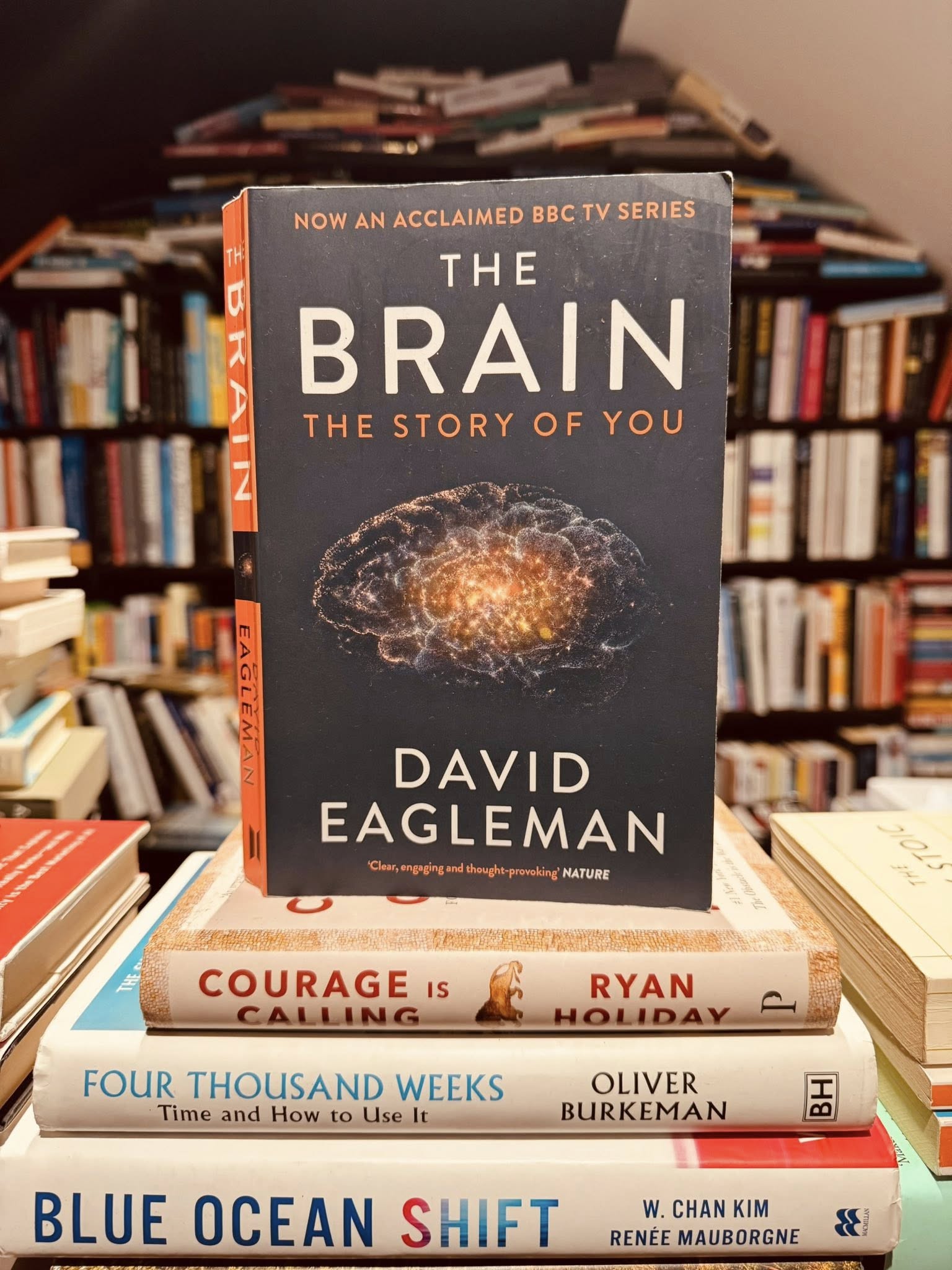
I have recently started to take an interest in neuroscience: mental health research, neurodevelopmental disorders, and mental illnesses. And have been working on coming up with new questions to ask surrounding the brain in order to find better research for learning how to solve its problems.
It’s still early days. However I am still discovering and it is going to be a subject of deep focus this year. The hardest problem most of the time is trying to come up with the best, and most hardest, problem to solve.
But once an idea has taken hold, it can take weeks, months, even years before reaching the ability of being able to redefine the question best in order to start navigating the right answer.
So you have this phase where the idea arises, or first appears in consciousness. Then there is this time of incubation when it bubbles beneath the threshold of awareness and there is a lot of uncertainty surrounding it still as you know it’s just an idea and it hasn’t been fully fleshed out yet.
And as you go away to learn other subjects you begin to pick up more ideas. Then, over time this new information reaches the idea and this all forms new connections, making new ideas meet, seeing more ways of thinking about the problem. And better still, thinking up hopefully even better questions surrounding the problem in order to develop better, deeper research into stronger answers.
Having a good creative problem to solve such as mental disorder prevention strategies, or wanting to know how to end mental illness and abolish it entirely doesn’t guarantee that you will. Nevertheless, a good creative problem to try and solve is better than no problem at all to solve. And what you will discover is each time you redefine the question, which can only happen after a significant amount of time has passed and both mental and physical energy has been exerted into its investment, that leads to better problem finding results.
The more you meditate on a problem, each day, the more you discover, the more your unconscious will bring you closer to its better solution over time. So don’t always eat lunch. Sometimes for lunch, or even many times, starve the stomach to feed the brain. For we starve the brain each time we fill it with empty distractions. You can always get something to eat later. But you can’t make up for neglecting your mind. It needs to be fed as much and if not more than the stomach.
Would you really want to eat McDonald’s each day for breakfast, lunch, and dinner? I’ve gone ahead and made your assumption to that as no. Then why feed your mind endless passive entertainment more than far longer than wise? If your mind ever becomes ill, we may blame neglect due to distractions as much anything.
Spend far longer than you think you need and take much longer on purpose. Deliberately procrastinate by reading other books before starting anything. When procrastinating, I’m not talking about doing nothing. I’m talking about productively procrastinating, where you do other things around it in order to make you and the thing better next time you return to do it. Practice purposeful procrastination, productively.
There are several categories of interest I’ve started to work on. Here are some so far but not limited to:
Perception. Consciousness. Environment. Challenge / Difficulty. Brain Development. Mental Activities. Brain Waves. Brain Health. Brain Disorder Prevention. Autism. ADHD. Drugs and Mental Health. Depression. Psychosis. Schizophrenia. Flow State Mastery. Happiness. Accessing Altered Brain States. The Brain Process. TMS. Reading. Writing. Running. Exercise. Success. Failure. Prevention Strategies. And more to follow.
How do you go from being extremely distracted, never able to focus, falling asleep at every attempt to read a book into being deeply focused, able to eliminate every distraction in your environment, and reading a book every day?
It’s not an overnight problem that can be solved. However, it can be solved. ‘How’ is the mission of this problem to solve. And in doing so, if achieved, will decrease your probability of developing mental health problems in the future. And so long as people have brains at risk of potential mental health problems, this is seeking to solve a perennial condition of the mind.
I did try taking a look at Ableton again in the last month after seeing my hundreds of draft papers written over the years. But I can’t. This is where my inclinations are compelling me to go. I’m more excited by this research now. Music will definitely be a large factor in this work. But music production isn’t exciting me anymore as much as studying psychology and psychiatry is. I’ve moved on. However I do think it’s heavily linked and extremely relative. I think there is absolutely a causal element when it comes to mental health and music. And we will be exploring that idea further on music and what it does to and for the brain. And that’s exactly what I’m trying to do: find causal links to it all, learn and develop strategies in preventing it under any event or circumstance.
So it wasn’t time wasted. If I tried to do what I am working on now 10-years ago, I wouldn’t have had that ability. And given everything I’ve done in the past 10-years, that has enabled me to learn this now. So if anything, that was preparation for getting ready to tackle this work to comprehend. And I’ve recently reached the ability to enjoy it.
You can’t help what your interests are. Or where you feel compelled to go. The reason should have always been obvious. Depression is at an all time high. Why wouldn’t you want to know how to make other people happier, or to ensure future lives are lived more happily? Better yet, why would I want to know the answers to these questions then keep all that to myself?
Get clearer on the questions. Find the research papers. It’s what you find second time round. Continuously redefine the problem. Asking better questions leads to better answers. And in doing so, you will discover far more than you even went looking for.
I’m enjoying working on this problem. If it has benefited one then it may indeed benefit another. And if it benefits another; then it’s worth working on.
I’ve dozens of new books to read this year and so much new research still excited to delve into. And I’m making it one of my goals to learn everything about it. How could I not? If you can master flow states, on command, then you can significantly reduce the likelihood that schizophrenia will arise.
This won’t work for everybody. For starters, I seem to have always been programmed to enjoy solitude. I’m highly introverted. Which means I love my own time with me, by myself. As I can get lost for hours at a time in my zone. However this may be an autistic thing. Or both. And having an autotelic personality matters too. So if you’re wildly extroverted and find it difficult to spend time engaged with nothing else but your own mind and body, alone, you may struggle to make sense of this, or find what it is we experience.
Millions of people are suffering from depression worldwide, with a large number prescribed to, and therefore also addicted to medication. Research indicates that rates of depression, anxiety, and other mental health issues have risen concurrently with the rapid, widespread adoption of technology—specifically smartphones and social media-starting around 2011-2012. While the relationship is complex, studies suggest that heavy technology use is a “prime culprit” in this, particularly for adolescents. Which to be honest, isn’t really a good thing I’m sure you would agree. Throw in artificial intelligence and virtual reality the problem is likely to only increase. Our job is to figure out then how to adapt ourselves into this ever changing world. As our brains aren’t all equipped for dealing with such exponential change so quickly.
It’s taking millions of years in evolution for our brains to get to where they are now. They’ve never had to deal with such a rapid change in the ways in which we now live our lives. We, and our children, are the experiment it’s being tested on. As it’s never been tested before ever the history of humanity. And this makes sense why mental health problems are on the rise.
So how we deal with that is an important part in understanding the ways in which we use and engage with digital tools in order to manage ourselves better so that it’s makes us better in the future, not worse.
Many people in our society struggle with and sometimes it’s even referred to as ‘loneliness’. And yet the opportunities for what one can do and life has to offer when alone are many.
Challenging the mind will inevitably lead to growth. And that will lead to radical positive change. Healthy brain development then comes through engaging in deliberate physical and mental activity whilst always continuously increasing its difficulty.
And technology has powerful potential for being able to do this for us also. But only when we use it the right way.
Boredom is what you experience when you do not know how to use time. This has never been a problem I’ve had. There are just too many interesting things, and even more so when you get the chance to not only do them, but to do them alone. Solitude is a prerequisite for deep sustained focus.
Big change is possible. But only if you’re willing to push hard enough to find it. If you do not, then unfortunately you’ll never get to experience it.