I’m going to add in the music that helped produce the piece for the day. You can listen along while reading too if you want. Music is a large part of the process for me. And I simply wouldn’t be able to do or say as much as I can without the music inducing flow. It makes the practice more enjoyable by getting lost for a while and just being able to forget the world.
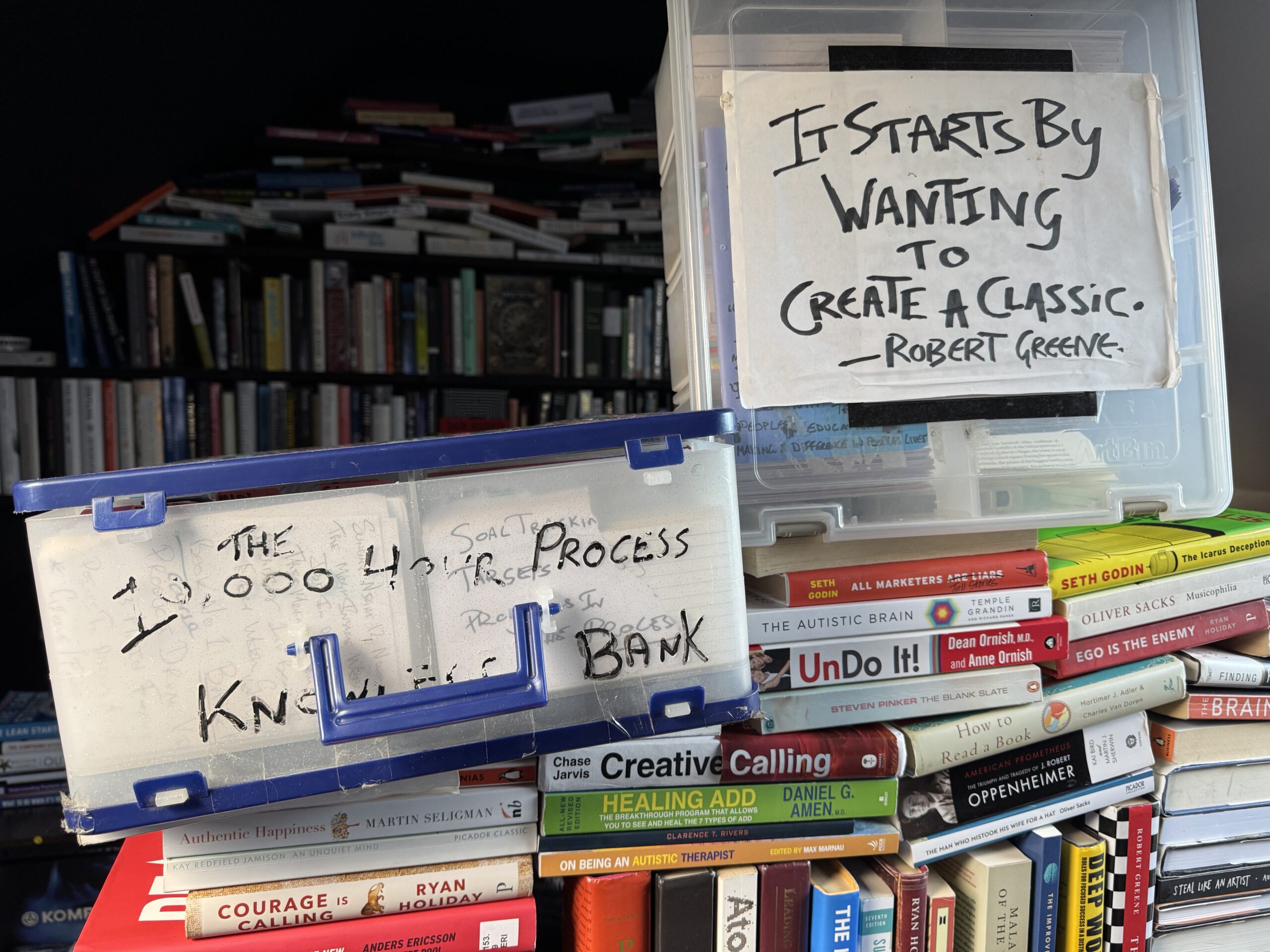
First, I will take a chance on a book in paperback. Then, I will also buy its counterpart audiobook. As I listen to it during the day when on the go not able to read it physically, I make Clips and Bookmarks in the audiobook app. These become your commonplace book notes: a reservoir of ideas and education containing what you see is the most important information from that book. I might buy the kindle version too in order to copy notes from the bookmarks and paste them into a Google Doc to get the information from it if I’m pushed for time and need it faster. You can take pictures with your iPhone then copy and paste text from images. Which is great when time is constrained. Then, organize the information into specific group categories.
Once you get to that point, that’s when you can actually start to use it, seeing patterns of where all these pieces may fit into different parts. For example, if a book teaches me something regarding ways of improving my reading skills on page 10, then another author has a good idea regarding reading on page 230, rather than this be disparate information from various resources that would be difficult to recall, simply consolidate the information. Take good notes and put everything useful into a single subdivision for each subject. In this case: Reading Intelligently.
What’s also important to note is while we are searching we are also looking for what isn’t there.
Whilst reading the book I am always writing my own notes all over the book, as reading it at different times sparks ideas to start firing in your mind. So writing all over the book everywhere, inside the front and back covers, start, middle, end pages, it doesn’t matter. Anytime you notice yourself having thoughts arise while reading, stop reading and be sure to get those thoughts on paper. You might not use them right away or you might even feel like these are just for you. But you never know. You may need them to help the work you aren’t aware you will do in the future.
I’m only picking up and seeing notes that were taken in books from 2017 that I not only never used but completely forget were there. Engage with the book as much as possible. If you notice yourself having ideas while reading, then you are learning from that content.
Capture this experience and bottle it. Then, when you are ready, it will open to you.
At night, after finishing reading our kids to sleep, this is the best time to sit down, to physically read slowly. In fact, there is no other better way to read. I’ve heard about speed reading before and back whenever I just started I thought I needed it to help me get through more quicker. But this wasn’t so much that I needed to read faster that was the problem, but rather, the desire to read in order to understand far more, far better. And speed reading is not the solution to that.
The real problem that was causing the inability to read well was not the inability to read faster but rather, an inability to read well at all. Which was how I spent most of my life, unable to read. But the fact was also this: it was still too early in the process. Too soon to know what to do.
But what I’ve come to learn about the human brain over the course of 10-years in this process now is that it is like a plant. It needs time to grow. There is no getting around this. You can’t skip the process. You can’t speed read your way to the finish line. There is no better way to attain mastery of your mind than making a serious commitment and investing yourself into at least the next decade in the process. Your brain, just like the plant or tree, needs sunshine and rain. But perhaps equally as important: time in order to flourish. If we simply empty a bucket of water over flowers, they don’t grow any faster. And if we keep them away from sunlight they will die sooner.
So books are like sunshine to the human mind and rain is like disgusting words slowly into the brain in order to soak up the knowledge to become absorbed into the roots of your mind. And speed reading is like trying to throw a bucket of water over your head all the while hoping you’ll sooner be far smarter and much wiser easier.
But, you won’t. That will rob you of comprehension. Philosophy is not a subject that you read in a hurry. And if you do, not much is going to change or happen to you or for you. Many times I go to sit down and read philosophy only to find myself 2-hours later not even 5-pages in even though I haven’t stopped.
How?
Because I got lots of new notes and spent much time thinking about these points and what to say about them. Philosophy causes you to think. You have to stop and ponder. I also find that with philosophy too much of it gets missed listening to it in audio. The material is just too dense. Much of the time you need time to digest a paragraph, or a page, and sit over it over for an hour, even a day of just contemplation and letting that point play on your mind as the rule of the day.
So don’t try speed reading and realise that if you are it is still too early and you are being impatient and it will take you longer to absorb the thing you are wanting and trying to do. You will have to go back over as it won’t sink in properly. The goal is to get deliberately slower, reading in order that you may not miss anything significant and get more from easily overlooked details.
You’re training your mind’s eye to function like a detective investigating to find new ideas.
Each part of a book that you find interesting you never want to forget and will want to use it again at some point, so you can highlight the pages, take pictures of them and upload them to clouds to always keep everything you learn in your pocket, never having to reach for them. But a better exercise is to physically sit down and engage with this content, transferring what you are reading with your hand into writing. You can do this in various ways and everybody has their own system for doing so. You may need to experiment for years until you finally find a system that works best for you, such as writing on index notecards and categorizing everything the way Robert Greene and Ryan Holiday have written extensively about for making their books. Or, if you prefer keeping track of everything in journals, that’s a great way to build large databases of information, creating a table of contents and index to remember everything you think forever.
Move the information around from time to time into other places too where you see it might fit together better in other ways. It’s the things you learn and discover while playing in the process that are the most fun. When you discover something after having performed the last action which you were feeling unsure of but still went ahead and done it anyway and in doing so you ended up finding what you wouldn’t have if you had listened to your fear and done nothing. You never went looking for it. But by the fact you are spending this time engaging with the process, and feeling unsure of yourself sometimes, by simply doing this work and going ahead anyway that in itself will generate more new work and create other paths unknown to you before.
Therefore, do not fear your creativity, even when it scares you. Work against that feeling by always doing what scares you. Each time you do anything in a state of fear and get to the other side, your brain becomes accustomed to this and the fear dissipates. You realise the only thing you were fearing was your fear itself. And nothing can hurt you or happen on the other side of it. Do not be afraid of your fear. Challenge it to the death, until you no longer fear anything.
Regarding what to do with all this information, it makes sense to break it down:
Where should this information live? What category does this fall under? Which topic does this point to? Psychology. Yea, but what psychology? Flow? Personality disorders? Philosophy. What philosophy? Stoicism, epicureanism, existentialism? Science. Yes, but which Science? The Universe? Life on Earth? Drugs? So you may need to create further sub-divisions for your sub-categories. You can see when it comes to finding interesting material across various subjects in order to learn how to try and fuse everything together why we need categorisation.
Within each field there are many different branches. And you are trying to grow a giant tree.
Therefore somewhere to consolidate all this information that makes sense to live in is a part of this process. By putting all these notes, thoughts and ideas that are scattered everywhere over a decade from books, notecards, apps, journals, hard drives, voice notes and plugging them together fusing information spanning thousands and thousands of pages into a quick reference, easily accessible, for every learning material is the way you can start then to make it your own.
Even Netflix has material worth keeping notes on. And reels. I’ve been harsh on reels in recent times but I should be a bit clearer. I do watch reels sometimes. However, the difference between the reels I watch compared to the noise I’ve seen others watching is I write down what I’m watching. It must be educational, useful or beneficial in some way to improve me. If the content takes up several hours of your week and you don’t feel compelled to write down anything after watching, then you are not using the technology to serve your purpose. You are a puppet being pulled by technology’s strings. Technology is great. But only if it’s making you better. Not worse.
The medium doesn’t matter. If you hear or find something that seems to resonate with you, write it down. Screenshot it. Then later, write it down. And back up everything. Even take pictures of your physical journals to have online backup copies of those in case anything happens to them.
You are simply not going to be able to remember everything you ever read or listen to, at least there is no way my mind could ever do that, unless you have a proper system, or “process” for storing and retrieving information. So after you finish a book, you will no longer need to keep going back to try and find what you want again, once you know how to implement this system.
Take a written note of the author and the work along with the title, chapter, subheading, including page number for indexing and quick referencing. Then, as soon as you are done, start the next book. But you might also be still far off from reaching this point. If you are always trying to read books that are above you then yes, in that case, you will need to return to these books to re-read them over and over, again and again. This is how I’ve managed to learn, to grow, to become more skilled at what I can do now. I stuck with these difficult books. I forced myself to read and re-read and re-read and re-read them, until they became a part of you.
So don’t worry if it doesn’t make sense yet or you struggle to understand how or why people get so much from reading this. You’re still in the process of learning and that comes later.
Not every book also will be pouring with notes you’ll feel compelled to quickly grab. You might only find a few points worth keeping upon first try, or notice halfway through you haven’t discovered anything that really resonates. You must persevere until the end. As this could be for several reasons. Either you are right and there is nothing that’s speaking to you. Or, you are not at that level yet. Not yet fully able to grasp everything it has to say and is able to teach you. Or, it might be what speaks to others in a way well, doesn’t really strike you, and there are other things that speak to you, which is why you shouldn’t focus on what the crowd enjoys but rather what you enjoy. Different meanings can be taken from the same text to different people. And this is perfectly fine. You don’t want to be chasing the most popular notes. You want to find what concerns you in this the most. That’s the point. In ‘there’ lives ‘your perspective’, your unique way of seeing the world around you, your individuality. All of the things that make you, you.
Never be satisfied with summary notes. If anyone teaches you something and you did not know it, that’s great. But the key is to go now and seek further on the topic yourself. Dig deeper and see what you can discover. Never assume others’ presentations of the work are the best version of it. Indeed, everyone will be out to make their best version, but that’s going to be subjective to what they perceive it to be as their best way to present it. Go deep. Seek more to it yourself.
Now, with a bank of deeply rooted knowledge beginning to plant well, containing the seeds of greatness by letting yourself only ever be consumed by great influences and inspirations with a deep focus towards timeless and classic, you have a catalog and can finally start branching out. Your own “branches of knowledge”.
Understand: at some point down the line you start to get there with this so you can do it. Therefore, my advice to you is, keep all of your notes and never throw any of them away. Ever. Pick up these notes from time to time and always begin again. If you have yet to start then a lot may not make much sense to you. In fact, it might even make you feel tired or sleepy, the sign of a weak mind. But you must work that muscle into shape and keep to this practice. What you will find is the more these impressions are made upon your mind, sooner or later they will stick, and your mind will start to act on them. And you will not be the same person who used to be.
Do not spend another day in idleness. Unless of course you are away on a trip for a couple of days. In that case, on those days, make use of it as a way to restore and enhance your consciousness. So that whenever you return to whatever it is you are working on, it will be better. Things that were not falling into place before, will eventually start falling into place. The mind then begins to grow. You reach a point where you start to see more and that’s when the patterns start to emerge. What you are learning is no longer simply being consumed, but absorbed, and you will begin to understand and develop unusually good comprehension skills, being able to navigate your way through learning anything, knowing when to stop and reflect.
Therefore, do not worry if this does not come easy to you. I assure you, this was not easy for me. Keep to the habit though and practice deliberately. The more you do this, you will feel extraordinary benefits, remarkable differences, and a complete change in your character. Things that used to bother you shall no longer concern you. You will move away shifting from your old self, becoming far more intelligent and psychologically robust, in control of your emotions and reactions, being able to grasp how to handle situations, confrontations, and relationships.
Take thousands and thousands of pictures of everything you do and keep all of them forever. Cherish them for they are a true treasure. If there is one thing you won’t regret, it’s taking all the pictures. Tracking everything in your life. A well kept log of your day to day existence, a logbook of your life. Your family. Everything you did together. Your children. Everything they brought home from school. Your education. Everything you ever did. That is going to be the most precious thing you possess. It will be the most important thing you own at the end of your life.
Once I told your mum about this process and she said, laughingly, “that’s some serious autism you have there.” I prefer to think of it as just wanting to always be organized and have everything arranged and always in its place. I really love structure, routine and organization; everything where it should be. That’s why I don’t sit down most nights until 10pm after getting up at 5am. It takes all that time doing everything that needs done in a day. But washing dishes or putting clothes out to dry late at night also doesn’t need to be a chore either. Again, you can turn a boring activity into a productive one. You can get through another hour or two of that book you’ve been meaning to listen to while doing the chores, you must still do anyway.
I know this sounds like a lot of work. And indeed, it is. But, it’s also a lot of fun too. There is never a dull moment. I can’t actually remember the last time I felt bored. In fact, I would find it difficult to recall any time when I ever experienced feeling bored. How can you when there are so many interesting things in the world to explore? An infinite amount of time wouldn’t be enough to get us through at the speed information is now being poured into the stream of our lives.
So if you are bored, I’m afraid that’s your own fault. That is a choice of your own. You can choose to stay bored, suffer miserably, stuck in the void, the dead end of Dead Time. Or, you can choose to make each and every moment of your existence matter and add up for something. You can choose instead to do meaningful work and engage in being useful.
The most important thing isn’t finishing. In fact, the whole point is to start with the idea that you are probably never going to be done. For how can one, considering there is far more to do in a lifetime than can be, even if you abstained from sleep, there still wouldn’t be enough time. So you might never finish. But that’s wonderful. I can tell you it is a joyous thing to wake up each day with a sense of mission, when you have your sights set on something that keeps you focused, alert, all the while you never ever experience the state of boredom. It is brilliant.
If I really love the book after the paperback then, I will also buy its hardback edition. They are more expensive. But paying the extra price makes it more valuable. They become investments. For these I see are the books for standing the test of time, literally too. Paperbacks fall a lot. Hardbacks don’t. I want one that can physically stand the test of time too. Your mum says “Yip. That’s definitely more autism you have there too. Nobody else would care to buy 3 copies of the same book and pay 10 times the price of that the book they already have!”
I strongly disagree with her though. And here is why: £7.99 for the new paperback. Or £1.67 for Used – Very Good. £9.99 for the audiobook. £5.99 for the kindle. But because I love it so much, and given the hardbacks are out of print, £65.00 for the hardback. I can’t help it. So a book could cost £100. But by the fact I’m willing to spend it means, at least to me, it’s worth more than £100. And I now have to ensure I get more than £100 in value back from this investment.
Understand: during the early phase of your creative life, we shall call it: the inspirational phase, you will be highly motivated and feel constantly inspired to want to do the work. But you will be consumed with passion constantly sharing inspirational quotations during this phase. You have not developed the world-class skills essential for progressing in this field. Nonetheless, this is a necessary chapter of the process. However, it is merely the entry point and beginning of the process. You will seek out motivational phases and inspiring quotes to keep you active and continually inspired to do the work. But your goal during this stage will also be to try and impress people. You will seek validation, confirmation and approval that your work is good based on others opinions, so you will be trying to do everything to impress them as much as possible.
However, what you won’t realise and because it is still far too early in your creative life, is that no matter how much effort you put into attempting to make the best work possible, you will be constrained to your infancy in this process. All this work you are doing is necessary but simply cannot be great because it is still far too early for you to even be able to distinguish the difference between what good work is or how great work is produced. And this component will not come naturally to you, for it does not come naturally to anyone. But it is still part of the process, to start out with something is always better than nothing.
An early first attempt, even if it fails, which it more than likely will, is better than succeeding too early, so you can learn more about what exactly it is you are doing and understand more about how to make better work. Achieving success through creative work by accident and not knowing how you managed to do so makes it difficult to replicate the results and this may leave you feeling dejected. After any early first attempts that go well but without knowing how or why, can delude you into believing you’ve got the golden touch. That you were made for this and you are soon going to be a star.
What usually occurs after flukes, or accidental accomplishments, once you begin to try something else again then it doesn’t work, after believing you’ve produced the best thing yet, the experience can be so devastating that many never recover from this experience of failure. When the same audience it was intended to please reacts with harsh criticism, even mockery. After doing something you thought was so brilliant, you are told by the people you intended it for that it’s terrible, making fun of you, making you feel like you are perhaps not cut out for this afterall and you’ve got everything wrong. And if you’ve been engaged with this work for years already and only get this reaction now, it can be hard to bounce back from.
What makes the difference between many at this point who would see themselves as a failure and not wish to carry on, or hide out of fear (many have committed suicide over this level of rejection), is whether you are going to choose let that feeling cripple and rip you apart and go to your grave knowing you had real creative treasures in you, but you didn’t perserve long enough to advance.
Or, will you choose to not let this knock you down? Will you choose to see instead that there are fair reasons for being criticised this way? Will you accept that failure is an essential step on every creative endeavour in life? Will you work hard, keep going and continue to cultivate your abilities until you learn to see why it’s not good and how to make the work better?
If you fail, that means you tried. There are thousands who never even make it past this point out of the fear of being rejected. So if you’ve already made it to the point of failure and rejection, well done. All you have to do from here now is learn. The problem is not that you are not capable of achieving extraordinary creative feats. The problem is that you do not possess the skills, knowledge, and understanding that can only come from a sustained self-apprenticeship.
You must be engaged for a prolonged period in deep isolation for your self education to occur. And 10-years is a minimum baseline to put yourself through for getting started. As that is when you will only start being ready to begin. If you have not got that level of experience behind you, then you still have a long way to go. Hence, this is another reason why you should never throw any of your work away. Especially that work you had high expectations for, that failed. Because even just seeing a glimpse of it again in the future, as a reminder of a single event that took place 10-years ago, can lead you to now producing remarkable results.
You will need to have an unusual amount of patience and be deadly serious about this commitment. That goes without saying. And a zero expectation that anything monetary or financial will change simply because you are doing the work. Money is not your goal during this phase. Self education is. And this will be the most important asset to your life. You will need to be willing to earn in other ways to support yourself investing in the materials you will need to reach mastery. You need to want to focus on learning, making that your highest priority. Without this necessary education, you are simply never going to get there.
There is no greater skill you can learn than mastery over words. To be able to say what you want and to be able to say it well. To be able to argue your point. To further your perspective, understanding, creativity and the ability to be able to study deeply any subject in the world you choose.