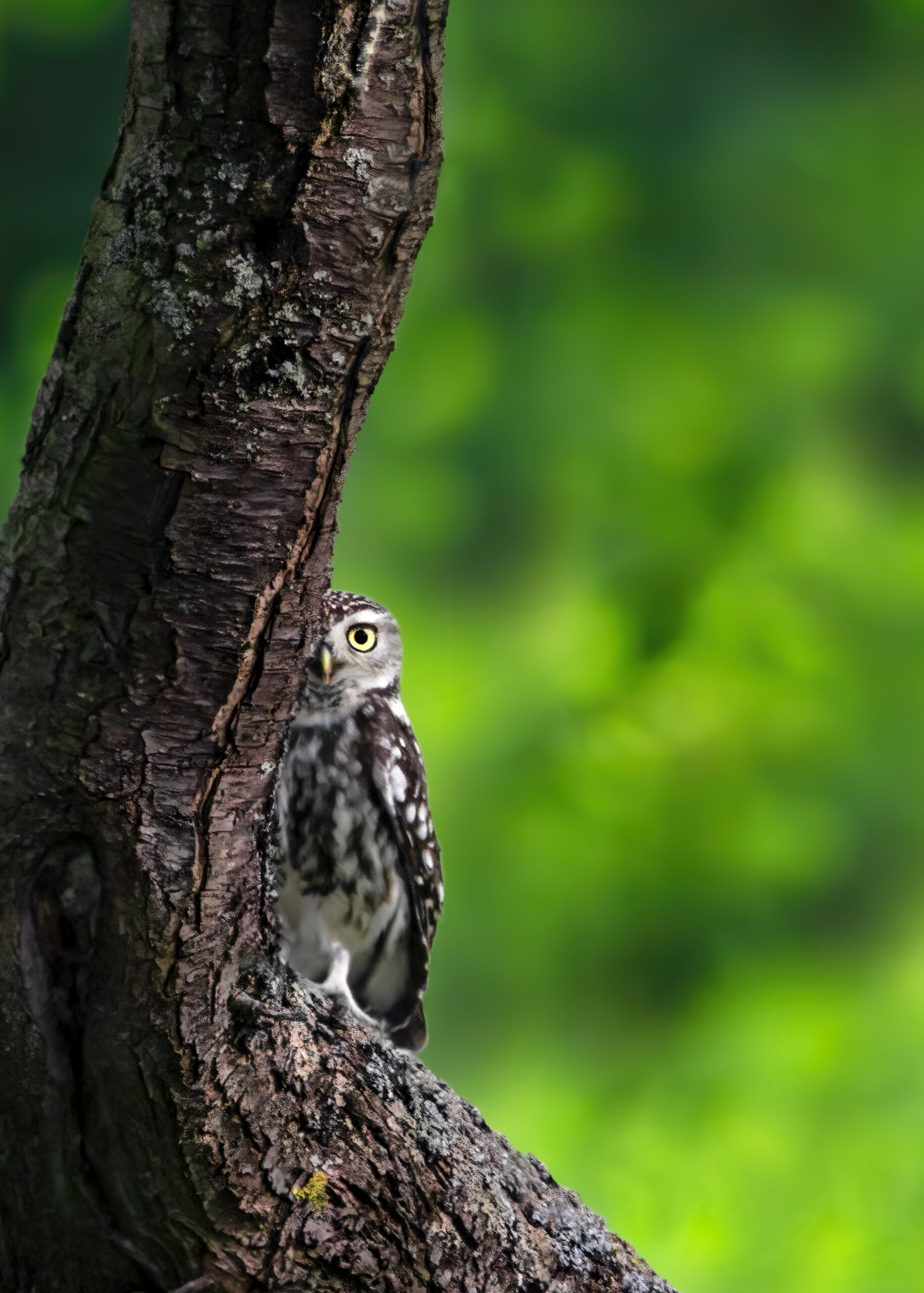
The human nature of an owl refers to the unique, often paradoxical ways these birds mirror, symbolize, or interact with human characteristics and cultural interpretations. While essentially solitary, instinct-driven nocturnal predators, they are deeply associated with humanity through mythology, folklore, and their own uncanny, almost intelligent behaviors.
Owls have extreme patience, something which you will need an extraordinary amount of, as you will need the ability to assimilate vast amounts of information over a large portion of your finite lifetime, being constantly engaged with your physical and mental environment to develop rare and unique skills.
Perceived as wise, they fit the bill with stoicism: thoughtful, unblinking with a ‘still’ demeanor. The owl is also more adapted to being on its own. Unlike social birds, owls are content to stick to their knitting, not adapting to human demands or changing their ways, which is sometimes interpreted as a sign of deep, quiet wisdom: the very goal that this work seeks to accomplish. And they have a strong reputation as being serious, wise and thoughtful creatures.
They possess generally aloof, cautious yet intensely focused temperaments, characterized by territoriality and a solitary nature, key characteristics that are also fundamental for achieving rare and unique work as sustained periods of deep focus and thought in isolation are prerequisites. They have extraordinary memories, and will remember human whistles for years.
Owls possess facial discs that give them a haunting, human-like appearance with varied vocalizations from gentle hoots to terrifying shrieks, which have caused them to be regarded as messengers, harbingers of change, or even voices of the dead in different cultures. Their reputation for intelligence is supported by their problem-solving skills, such as adjusting hunting strategies. They are solitary, quiet contemplators. And have a need to be alone.
Unlike social birds, they live largely solitary lives, fitting the human archetype of the solitary, wise philosopher: a silent, but very astute observationalist. Their eyes are fixed in tubes, similar to binoculars, rather than rolling, which forces them to turn their heads up to 270 degrees to observe their surroundings, mimicking a highly focused human gaze. And this allows them to perceive depth and distance with great precision, an unusual recognition of patterns that others overlook and ignore. They sit still long enough to notice what isn’t being said. They are experts in perception, waiting, watching and striking when necessary.
They fit the modal as a transformational guide, often perceived as a meaning of transition, or navigating through the darkness of life’s challenges, making them a personal totem for “overcoming obstacles”. We could say to counter Ryan Holiday’s bestseller: The Owl Is The Way.
Their large, forward-facing eyes represent deep focus, with an observant gaze, constantly aware of their environment and always watching the outside world, whilst hidden in the shadows. Universally they are clever and associated with wisdom, appearing in Greek mythology as the companion to Athena, the goddess of wisdom, representing knowledge, strategy, foresight, and victory. They are sentinels of the night with an ability to see what others do not. Its vision is precise where others are blind. Where others might experience fear, the owl thrives in darkness.
Nocturnal in their habits with haunting calls and silent flight make them seem quiet, watchful and sometimes even ominous guardians. Their nocturnal nature and sharp senses connect them to hidden knowledge, urging to trust inner guidance and look beyond illusions. There is a belief that owls have protective qualities, serving as guardians. The owl guides us to follow our intuition and let go of the situations that are no longer serving us. It calls us to be adaptable and allow the shift to take place, instead of fighting it. The owl cautions us against reacting from our ego, since the change that is coming our way could be a blessing in disguise. People believed that upon sighting the owl, listen to your intuition and respond with wisdom and foresight.
So if the owl shows up, it means ‘meditate’ in silence and in darkness for a few minutes each evening for the next few days and see what is revealed to you. Be alert to any deception on the part of others, whether they’re aware of it or not, and look closely behind any guises that they might wear. In some spiritual traditions owl hoots are seen as messages urging listeners to trust their intuition or, conversely, as a warning of upcoming, often negative, transitions. It is a ripe period to tap into intuitive wisdom available to you.
Quietly observe your environment, watching and listening for signs that will give you answers to any questions you may have. It is a significant time for prophecy, and you will see, hear or feel events before they actually happen.
Your most creative cycle now is night so set aside time in the evening to work on the project. However the owl doesn’t merely symbolise, but comprise, and therefore qualifies as exactly what this project seeks to accomplish: achieving wisdom, cultivating extremely enjoyable deeper states of focused consciousness, and increasing your intelligence.
This is about human nature, however that in itself represents the animal kingdom. For each of us has living inside of us our own animal, either good or bad psychological traits that we are perhaps unconsciously and completely unaware that we even possess, and need to learn.
The owl is a fundamental metaphor for fusing all three of these laws to living your best life:
WISDOM: PHILOSOPHY
FOCUSED: PSYCHOLOGY
INTELLIGENCE: NEUROSCIENCE
Ultimately, what this seeks to achieve is the ability to attain happiness through wisdom and by using your mind for far greater things with your life than merely what technology wants. In a world where everyone else is becoming anxious, unsteady and feeling lost, this is a mission to find not a way back but a better way through the noise and how to take advantage in these extraordinary times we’ve been born into so that our lives in the future flourish, not diminish.
What we are saying here is this: if you wish to go on this journey, you will need cultivate and posses the qualities of an owl. And if you can produce the characteristics and qualities of an owl, this is in fact ‘a new hope’ for you.
When the owl wings in as your spirit animal, it’s time to face the shadows. Owl as a totem animal belongs to those who find wisdom in silence.
You must become comfortable in solitude. There is nothing to fear. An owl does not panic. Its most powerful skill is learning to see, the greatest skill an artist can cultivate, when everyone else is too afraid to even look.
Invoke owl as your power animal when you need to see the truth. The owl symbolises this connection, between death and rebirth. But it’s not a literal death. It is a transition. The end of an illusion.
“A wise old owl lived in an oak,
the more he saw the less he spoke.
The less he spoke the more he heard,
Why can’t we all be like that wise old bird?”
– A WISE OLD OWL.
IDEATION: THE CREATIVE PROCESS OF
MEDITATIONS ON LIFE AND HUMAN NATURE [HOW TO FIND MEANING AND HAPPINESS IN AN EVER INCREASING DEPRESSED WORLD]